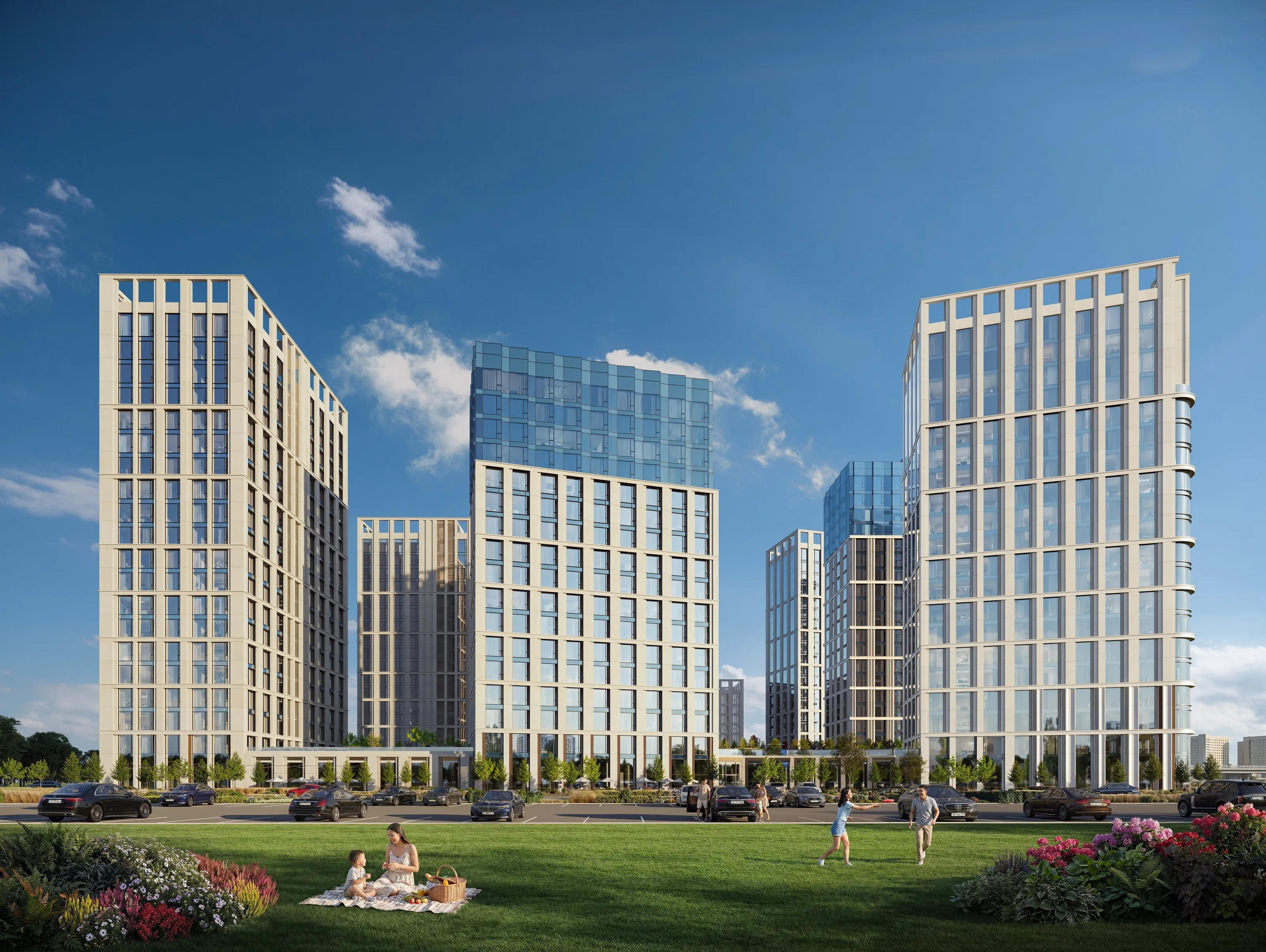
Render for sales vs render for competition
The same building, the same drawings, two briefs. One image goes to an architecture competition jury, the other hangs on the sales office wall. If you order them the same way, one of the two will not work. Here is where they differ.
Who looks and what they look for
A jury looks at a render as architecture: massing, proportion, how the building meets the street and how it fits its surroundings. The jury is deciding whether it is a good building.
A buyer looks at a render as their future life. Where to park, where the child will play, what the view from the balcony is like in the evening. The buyer is deciding whether they want to live there.
Everything else follows from that difference: cameras, people, weather, even the season. An image that tries to please both the jury and the buyer usually works poorly for both.
Cameras
For a competition the camera goes where the architecture reads best. Often higher and further away, with a longer lens, so the verticals stay straight and the massing is not distorted. Aerial views are common, because they show the plan and the neighbouring buildings.
For sales the camera stands at eye level, where the buyer will be: at the entrance, in the yard, on the balcony, at the window of the apartment they are choosing. An aerial is rarely needed, mostly to show where the building is.
The lens is chosen differently too. A wide angle at eye level makes the yard look bigger than it is, and the buyer will notice when they visit the site. So for sales we keep the focal length close to how the eye sees and show space through the choice of angle.
People
A competition render has few people, at the correct scale, doing nothing distracting. They are there to show the size of the building.
In a sales render people show how life works here. Neighbours talking, a child on the swings, a couple having coffee on the terrace. The buyer should be able to picture themselves in their place. Scale still matters: if a person in the frame is too big or too small, the buyer stops trusting the whole image.
There is also a third case: a developer competition, where the jury judges the product. Then the image sits closer to a sales render, but without scenes that will not pass an expert review. No cars on the fire lane, no children by the water.
Weather and time of day
For a competition we choose even, neutral light that shows the facade clearly. Overcast or soft sun, with no effects that the building could get lost behind.
For sales the light is chosen for what the buyer should understand. A warm evening with lit windows shows that people already live here. Snow and lit entrances show that it is warm inside. Rain in the courtyard can give one of the strongest images in the set, if the project has canopies and lighting worth showing.
The season depends on the launch date and on the project itself. If sales open in winter, a summer image shows what the buyer will only see months later. In that case a winter shot with a lit entrance is more honest, and it is often stronger.
Surroundings and drawings
Both images must match the drawings. A buyer who moves in and finds a different facade will come with a claim. A jury that finds a different massing will disqualify the entry. The only difference is what surrounds the building.
For a competition we show the surroundings as they are, including the ugly neighbour, because the jury knows the site. For sales the surroundings are real too, but we choose the angle where they help the image and the season when the trees look their best. We will not add anything that is not on the site.
What to write in the brief
Say which image you need. "Ten renders" is not a brief. "Six eye-level sales images for the launch and two competition views for the city panel" is a brief. If you need both sets, say so at the start. They come from one scene, but the cameras, the staging and the lighting are different, so we plan and price them as separate angles.
It also changes what we will ask you for. A competition set needs the context model and the site plan first. A sales set needs the apartment mix, the target buyer and the list of places the images will be used, because the balcony view of a family apartment and of a studio are shot differently.
Before you order
Write one sentence per image: who will look at it and what that person should feel or understand. Attach it to the brief. We choose the cameras, people and weather from these sentences, and the second round of comments is usually short.
Read us in Telegram
Work in progress, backstage and short notes between articles.